
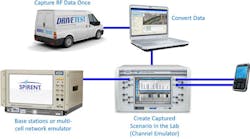
Many see drive testing–the process of testing cellular systems and equipment by literally driving around with live mobile devices in a car or van—as the ultimate test of a cell phone or base station. However, drive testing incurs significant costs and liabilities while offering very little in terms of repeatability. For many years, testing and R&D labs have dreamed of “virtual drive testing” or the laboratory-based repeatable replication of live field environments. But the methods were always just out of reach of available technology. While current and emerging wireless technologies (specifically LTE and LTE-Advanced) compound the complexity required of virtual drive testing, the very factors that make it more difficult to create field conditions also make it more important to replicate those conditions. With this as a market driver, the industry has recently been able to deliver virtual drive-testing solutions that are both accurate and repeatable.
Although drive testing is valuable at every step in the wireless-service chain, it is often for different reasons. Network operators use it to fine-tune while “live,” to ensure that soon-to-be-deployed mobile devices don’t drain network resources under specific conditions, or to evaluate the performance of a mobile device. Mobile-device and silicon-device manufacturers use it to ensure competitive device performance in the field. Meanwhile, infrastructure vendors evaluate the capabilities of base-station products under varying radio conditions.
The common thread in all of this testing is the fact that a live network, operating under real-world conditions, is completely unpredictable. This very aspect of a live network leads to a lack of repeatability and devalues the results of testing. When an issue is discovered, the only way to objectively evaluate new software or an antenna design is to replicate the same conditions under which the bug was found.
The three steps required for successful virtual drive testing are:
1. To capture (record) field conditions from a physical drive route.
2. To convert the captured data into a form that is usable by available test equipment.
3. To convert that data into an effect imposed on cellular signals in the lab.
While this is an oversimplification, there are critical details and potential pitfalls that must be addressed at each stage of the process.
Capturing Field Conditions
To ensure that captured field data are useful, they need to meet certain criteria. In most cases, commercially available cellular scanners simplify the process–but with some limitations. Scanners are specifically designed to capture RF parameters. The challenge, however, lies in the capture of scenarios as seen by multiple-input multiple-output (MIMO) antennas.
MIMO is a critical success factor in LTE and LTE-Advanced deployments. All of the “headline” data rates advertised for these technologies are dependent upon the optimal use of multiple antennas to create multiplexing in the spatial domain. The physical design and orientation of MIMO antennas therefore play a crucial part in the quality of the signal seen by a receiver. However, the antennas installed on most commercial scanners bear little resemblance to the antennas used on commercial mobile devices and/or base stations. While scanner manufacturers continue to work on addressing this discrepancy, commercial or pre-deployment mobile devices are currently the capture tool of choice for MIMO testing.
This, in turn, requires that the device be capable of capturing RF data and passing it to a recording device (usually a PC with purpose-specific software). Some commercial devices may not be able to capture and record location information (e.g., Global Positioning System [GPS] coordinates). In those cases, a secondary mechanism must be in place to capture and time-stamp location information.
Many practical challenges arise in the conversion of captured field data into a format that can be replayed in the lab, such as the following:
1. No scanner or user equipment (UE) will capture RF conditions perfectly. The key to converting captured data is to understand the limitations that are inherent in the data. A good example of this is the sampling interval of the capture device. Most capture devices will report RF measurements 10 to 20 times per second. This may appear to be fast, but the RF environment will be changing much faster (>100/s). This sub-sampling of the environment must be accounted for and corrected. Typically, the sub-sampled data is removed using a complex filtering approach, after which fast fading can be statistically generated using standard (e.g., Rayleigh or Rician) models.
2. With LTE, mobile devices continually feed information about the RF link to the network. For the process to behave correctly, the propagation delay and approximate RF conditions must be realistically applied to both the signal from the network (downlink) and the signal from the UE to the network (uplink). Because uplink path loss is not normally available, it is a generally accepted practice to model this with the same path loss observed on the downlink. Although this is not a perfect emulation, it has been found to be acceptable.
3. It is also desirable to reduce the number of channels required to simulate the RF environment. In the real world, as a mobile device moves throughout the network, it will communicate with many different cells. In practice, it is not feasible to simulate all of these cells independently. A mapping approach takes the RF information from all of these separate cells and then selects the key information to be simulated on the far smaller number of cells available in the laboratory.
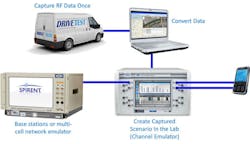
Commercially available software addresses these issues in a format based on a graphical user interface (GUI). Once all of the hardware is in place, the simulation process is quite easy. The below image shows a basic connection example. Commercial base stations or network emulators are connected to a channel emulator, which “plays back” the RF conditions via data that has been captured and converted. The only limitation is the amount of physical hardware available to replay the simulation.
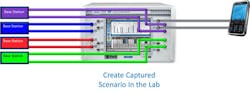
For example, simulating a multi-cell LTE system might require eight RF channels in the channel emulator. Each 2x2 MIMO cell would require two uplink channels and two in the downlink. This requirement for a large number of independent channels has been addressed by recent product introductions, which provide the capability to support up to eight RF channels within a single unit.
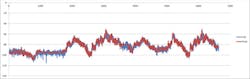
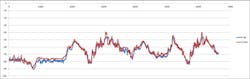
Care must be taken to ensure that the loss is accounted for between the channel emulators and both the UE and network. The simulated signal levels delivered to the device under test will then reflect what was detected in the field. The below images show the results from a typical conversion, comparing captured and replicated signals based on three parameters: reference signal received power (RSRP), received signal strength indication (RSSI), and throughput. This field data was captured with a UE during a typical drive route. The captured data was then converted and replayed in a laboratory environment, where the same mobile used in the field was used to capture the results of the simulation.
To ensure that MIMO-based LTE delivers on the expectations of increased throughput, MIMO-capable devices and infrastructure must be tested in as realistic an environment as possible. The high cost and non-repeatability of live drive testing translates into a dire need for better testing alternatives. Thankfully, the use of a carefully designed procedure for the capture, conversion, and playback of a real-life, complicated RF environment can enable the testing of MIMO-based LTE under realistic and repeatable conditions.
Paul Collins is a Solutions Architect at Spirent Communications’ Wireless business. A 14-year industry veteran, he has made various standards-body contributions–
specifically in the area of location-based services.
Madhusudhan Gurumurthy is a Senior Applications Specialist at Spirent Communications. He joined Spirent in 2006 and has served in product development, product marketing, and standards strategy roles.