
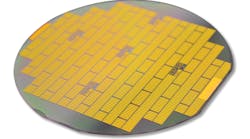
To reach its current state of success and industry acclaim, gallium-nitride (GaN) technology had to overcome a number of performance challenges. Now, the technology may reach new heights, thanks to extended performance. Some GaN research and development efforts are currently underway with backing from the Defense Advanced Research Projects Agency (DARPA). TriQuint Semiconductor, Inc. has received a $2.7-million contract from DARPA to triple the power-handling performance of GaN devices and circuits (see figure). In a similar move, DARPA has given RFMD a $2.1-million contract to enhance the thermal efficiency of GaN circuits.
Both of these contracts are in association with the Near Junction Thermal Transport (NJTT) effort of DARPA’s Thermal Management Technologies (TMT) program. The NJTT initiative focuses on thermal resistance at the “near junction” of the transistor die as well as the device substrate material. These areas can be responsible for more than 50% of operational temperature increases. NJTT is expected to lay the groundwork for monolithic-microwave-integrated-circuit (MMIC) performance enhancements like reduced size, weight, and power consumption while increasing reliability and output power.
For TriQuint, this effort will build on both the firm’s GaN-on-silicon-carbide (SiC) technology and RF integrated circuits (RF ICs). By combining its GaN-on-SiC process technology with diamond substrates and new thermal-handling processes, TriQuint seeks to significantly reduce heat build-up. In doing so, it hopes to enable GaN devices that can generate more power. Among TriQuint’s partners in this program are the University of Bristol (known for thermal testing, modeling, and micro Raman thermography) and diamond-substrate specialist Group4 Labs. In addition, Lockheed Martin will evaluate the results of the program for its projected impact on future defense systems.
For its part, RFMD hopes to improve both power density and power-handling capability by combining thermally enhanced diamond substrates with its GaN-on-SiC technology. RFMD’s partners in the program include the Georgia Institute of Technology (known for thermal testing, modeling, and micro Raman thermography), Stanford University (a leader in thermal measurement of the interface layers within a transistor die), Group4 Labs, and Boeing. Boeing plans to evaluate the resulting technology to assess its projected impact on future defense systems.
According to DARPA, varied NJTT approaches may be implemented to reduce the near-junction thermal barrier. These include the use of high-thermal-conductivity diamond substrates, which will replace lower-conductivity materials like SiC, Si, and sapphire. In addition, low-conductivity epitaxial and transition layers at the interface of the GaN active layers and the substrate can be removed by etching or other techniques. DARPA also points to the introduction of liquid cooling in the near-junction region as well as the use of metrology and modeling—both to address the challenges of measurement verification at this scale and quantify the thermal and electrical performance of the GaN devices.