Antennas Give Radio Telescope Chance For "Early Science"
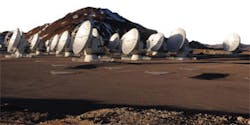
WHEN IT IS COMPLETED IN 2013, scientists will use the Atacama Large Millimeter/submillimeter Array (ALMA) astronomical observatory to study portions of the universe in detail beyond what is provided by current technologies. As a result, scientists will be able to study the origins of galaxies, stars, and planets. Located on Chile's 16,500-foot-high Chajnantor plateau in the Andes mountains, the observatory is already enabling them to do initial scientific experiments, or "early science," thanks to the installation of 13 12-m antennas.
For the first time, those antennas are being linked together with other antennas, which were previously installed near the observatory. The latter antennas were made in Europe and Japan. This link will allow them to begin operating as a single radio telescope and perform early science. For example, one science experiment will use ALMA to unearth the behavior of about 50 of the most massive black holes in the universe. Those black holes were previously hidden in the dusty material of their galaxies.
Manufactured by General Dynamics SATCOM Technologies, the 115-ton, highly specialized antennas form a crucial part of the 11-mile-wide international astronomy project (see photo). In addition to its antennas at the high site, General Dynamics has delivered another four antennas, which are now in various stages of customer acceptance testing at the ALMA Operations Support facility 7000 feet below the Chajnantor plateau. Once they are complete and ready for operation, the antennas are carried by a custom-built transporter to the plateau. There, each one is attached to a concrete platform and connected to electrical power, fiber optics, and other services.
ALMA construction and operations are led on behalf of North America by the National Radio Astronomy Observatory (NRAO), which is managed by Associated Universities, Inc. For more information about ALMA, visit http://www.nrao.edu/index.php/about/facilities/alma.