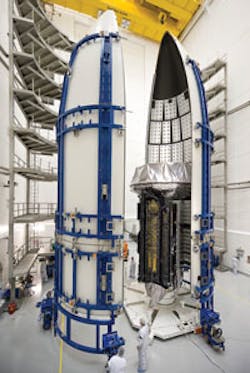
On Feb. 24, following years of planning and anticipation, the first-ever Mobile User Objective System (MUOS) satellite was successfully launched from Cape Canaveral Air Force Station in Florida. Built by Lockheed Martin for the US Navywith the contract originally awarded back in 2004the satellite was launched aboard a United Launch Alliance Atlas V rocket (see photo).
The MUOS constellation will replace the legacy Ultra High Frequency Follow-On (UFO) system, providing significantly improved assured communications (including simultaneous voice, video, and data) for mobile warfighters. A single MUOS satellite will provide 4 times the capacity of the entire legacy UFO constellation of 10 satellites. The satellites also include a hosted legacy UHF payload that will be fully compatible with the current UFO system and legacy terminals.
The first MUOS satellite and associated ground system will provide initial on-orbit capability this year, with the four-satellite global constellation achieving full operational capability in 2015. When complete, it will extend UHF narrowband communications availability well past 2025. Lockheed Martin is the prime contractor and system integrator for MUOS. The Navy's Program Executive Office for Space Systems (Chantilly, VA) and Communications Satellite Program Office (San Diego, CA) are responsible for administering the MUOS program.
Editor's Note: To learn more about the MUOS program, be sure to read the article "MUOS Heralds Future Of Military Satcom" in the 50th Anniversary Issue of Microwaves & RF.