Techniques for Making Measurements of Noise-Like Signals with a Spectrum Analyzer
Download this article in .PDF format
Many of today’s communication formats, such as W-CDMA, cdma2000®, and WLAN, produce signals that are noise-like in nature. Accurately measuring these types of signals requires tools and setups that are different than traditionally used for continuous-wave (CW) signals. To get a better understanding of how to deal with noise-like signals, let’s examine the best approach for measuring them, and look at the tools available in modern spectrum analyzers for quickly and accurately making absolute and relative power measurements.
Selecting Detectors
In most cases, two detectors are used for measuring noise-like signals, either a sample or average detector. A sample detector provides a single sample in each trace point on the display. The sample is taken between each trace point as the spectrum analyzer is swept and displayed in the next trace point. The average detector averages, on a linear power scale, all samples between two trace points. The average value is then displayed in the next trace point. With noise-like signals, peak or normal detectors should not be used, since these detector types do not provide a good statistical distribution of the signal and can yield inaccurate power measurements. Peak detectors are primarily used to measure CW signals.
One of the major challenges in measuring noise-like signals is the variance in measurement results caused by the nature of the signals themselves. Several averaging techniques can be used to reduce this variance. Most notable are trace averaging, video bandwidth (VBW) averaging, and averaging with the average detector. While these techniques can be combined, normally only one is needed.
Trace averaging is simply averaging each trace point from one sweep to the next. When trace averaging is turned on, the detector is auto-coupled to the sample detector. Because it can be used with any detector type it is one of the most common averaging techniques and is supported on almost all spectrum analyzers.
Another approach is to reduce the analyzer’s VBW to less than the resolution bandwidth (RBW). In many spectrum analyzers, the VBW-to-RBW ratio defaults to 1, providing a small amount of averaging. In most cases, a VBW-to-RBW ratio of 0.1 sufficiently reduces the variance in the majority of signals to an acceptable level.
In modern spectrum analyzers, a better approach is to use the average detector. When the average detector is selected simply increasing sweep time applies more averaging. Increasing the sweep time also increases the number of samples taken and averaged between sweep points, thereby reducing signal variance.
A key tip when measuring a noise-like signal is to make sure you are averaging on a power (RMS) scale and not a logarithmic scale. This is because the log of the average is not equal to the average of the log. Averaging a noise-like signal on a log scale can cause an error as great as -2.51 dB. This can easily happen when using older analog intermediate-frequency (IF) spectrum analyzers. In modern spectrum analyzers, simply set the Average Type to Power (RMS) to ensure accurate measurements. In Agilent’s X-Series signal analyzers, for example, the Average Type is applied to all of the previously discussed averaging techniques.
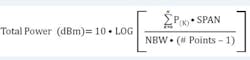
Making Accurate Power Measurements Accurately measuring the power of a noise-like signal can be challenging. The total power of the signal is not at a single frequency point as with a CW signal. Instead, it is spread across the entire bandwidth of the modulated carrier. Modern spectrum analyzers like Agilent’s X-Series often have multiple tools for accurately measuring noise-like signals. The X-Series analyzers, for example, feature a flexible set of band power, band density, and noise markers, which integrate the total power within a specified bandwidth and display the power in dBm or dBm/Hz. The power is computed as follows:
and

where
P(k) = the power (in mW) of a trace point within the integration bandwidth;
SPAN = the selected span of the spectrum analyzer;
NBW = the noise bandwidth of the RBW filter, in X-Series signal analyzers NBW = 1.05 x RBW;
CBW = the integration bandwidth; and
Points = the number of trace points in the span.
The power spectral density is the power contained in a 1-Hz bandwidth of the total power.
In the case of the X-Series analyzers, the detector is automatically set to average and the averaging type to power (RMS) when the band power, band density and noise markers, are selected, thereby preventing result errors. Additional smoothing of the trace can be achieved using the averaging techniques previously discussed.
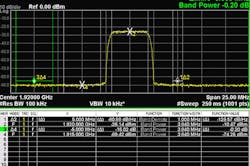
As an example, Fig. 1 displays the band power markers for making measurements on noise-like signals. Marker 2 indicates the total power (dBm) of a W-CDMA carrier in a 3.84-MHz channel bandwidth. Marker 1 is set to display the power density in a 1-MHz bandwidth relative to the total power of the carrier (dBc). Marker 4 displays the total power of the lower adjacent channel. Marker 3 is the relative total power (dB) in the lower alternate channel to marker 4. Clearly, these markers enable ease and flexibility for making extremely complex absolute and relative power measurements on noise-like signals.
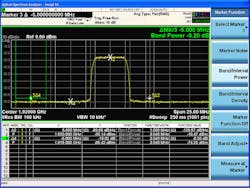
1. This image shows an example of the X-Series’ band power markers.
One-Button Measurements
Modern signal analyzers like the X-Series analyzers often have a built-in set of power measurements that allow for a one-button approach to making standards-based power measurements on noise-like signals. Such measurements include Channel Power (CHP), Adjacent Channel Power (ACP), Occupied Bandwidth (OBW), and more (Fig. 2).
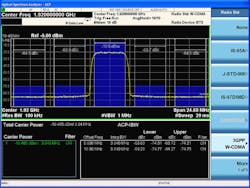
2. This is an example of a W-CDMA carrier X-Series ACP measurement. The carrier power of –10.5 dBm is displayed for the 3.84-MHz carrier. The power in the ±5 and ±10-MHz adjacent channels are measured and displayed. These results are provided for both the absolute power (dBm) and power relative to the total carrier power (dBc).
Summary
Most modern signal analyzers have a flexible set of detectors, averaging types and markers for making flexible and complex measurements of noise-like signals quickly and easily. A large set of built-in power measurements are available that can be configured for many of the current and emerging standards. The unique coupling of detectors and averaging types ensure that the measurement results are accurate.
Bob Nelson is Agilent Technologies’ MXA (N9020A) Product Support Engineer. He has spent the last 14 years with the company, supporting the Agilent field organization and customers with application-focused measurement requirements. Nelson holds a degree in Electrical and Electronic Engineering from California State University, Chico.
About the Author
Bob Nelson
MXA (N9020A) Product Support Engineer
Bob Nelson is Agilent Technologies’ MXA (N9020A) Product Support Engineer. He has spent the last 14 years with the company, supporting the Agilent field organization and customers with application-focused measurement requirements. Nelson holds a degree in Electrical and Electronic Engineering from California State University, Chico.