Mobile-Phone Antenna Passes Hearing-Aid Tests
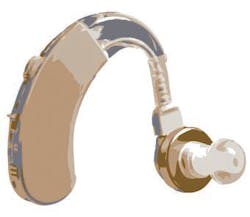
ACCORDING TO THE ANSI C63.19-2007 hearing-aid-compatibility (HAC) specification, at least half of all mobile phones on the US market must have an RF interference level of category "M3" or "M4." Techniques have been demonstrated that decrease the near-field emission of embedded antennas. Yet the industry still lacks potential designs for a bar-type mobile phone with an embedded antenna that satisfies HAC requirements over the five WWAN bands of GSM850/900/1800/1900/ UMTS, in addition to the three LTE operating bands, LTE700/2300/2500. At Taiwan's National Sun Yat-sen University, however, Shu-Chuan Chen and Kin-Lu Wong recently presented an HAC bar-type mobile-phone design. Its embedded antenna covers an eight-band LTE/WWAN range while meeting the ANSI C63.19-2007 specification for those operating bands.

The researchers used a coupler-fed, on-board, printed inverted-F antenna with a bypass radiating strip. That strip was connected to the antenna's radiating portion to achieve wide upper and lower bands (covering 1710 to 2690 MHz and 698 to 960 MHz, respectively). As an added benefit, use of the radiating strip allowed the engineers to effectively smooth variations in the antenna's input impedanceespecially in the case of frequencies over the upper band.

The antenna was placed at the bottom edge of the mobile phone's system circuit board, where it was surrounded by an L-shaped ground plane. As a result of this approach, the excited surface currents on the main ground near the acoustic output can be greatly decreased. In fact, this ground-plane placement can bring about decreased near-field strengths of both the emitted electric and magnetic fields on the observation plane above the acoustic output.

The mobile phone with an embedded LTE/WWAN antenna qualifies as a hearing-aid-compatible wireless device, as the eight operating bands can have an HAC category rating of at least M3. The researchers also analyzed the effects of the user's hand holding the mobile phone on the performance of the antenna. See "Hearing Aid-Compatible Internal LTE/WWAN Bar-Type Mobile Phone Antenna," Microwave And Optical Technology Letters, April 2011, p. 774.

See Associated Figure

Please or Register to post comments.

Newsletter Signup

Webcasts

GaN Roundtable: The State of GaN Reliability Today

Wednesday, April 3rd, 2013, 2:00 pm ET. Gallium nitride (GaN) has come a long way over the past few years in terms of affordability, industry acceptance and, in particular, reliability. In this webcast roundtable, a panel of expert speakers will assess the current state of GaN reliability, along with offering predictions for its future.

Click here to register!

Whitepapers

New App Note: Best Practices for Making the Most Accurate Radar Pulse Measurements
Sponsored by Agilent Technologies
Download this app note

Agilent Technologies Complex Modulation Generation with Low Cost Arbitrary Waveform Generators - Agilent's Trueform Architecture for Wireless Applications
Sponsored by Agilent Technologies
Download this white paper

Browse more white papers from Microwaves and RF

Connect With Us