Space-Fence Construction Is Set For 2013
Next September, the Air Force will begin construction at its first site for Space Fence, an advanced ground-based radar system. Located on Kwajalein Atoll in the Marshall Islands, this site’s construction puts the program on track to meet its 2017 initial operational capability goal. Using new S-band technology, Space Fence will enhance the way the US detects, tracks, measures, and catalogs orbiting objects and space debris. In addition to improved accuracy, Space Fence will provide the US with better timeliness and increased surveillance coverage.
Once Space Fence is operational, the Air Force will be able to decommission the aging US-based Air Force Space Surveillance System. Installed in 1961, that system was not designed to detect and track the hundreds of thousands of smaller, orbiting objects that are in space today—never mind cataloging them. With its greater sensitivity, Space Fence will be capable of detecting, tracking, and measuring an object the size of a softball orbiting more than 1200 miles in space. Being an uncued tracking system, it also will provide evidence of satellite breakups, collisions, or unexpected maneuvers.
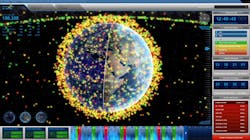
Space Fence will provide this precise positional data on orbiting objects in both low-earth (primary) and medium-earth (secondary) orbits (see figure). Data from Space Fence will be fed to the Joint Space Operations Center at Vandenberg Air Force Base, CA. That data will be integrated with other Space Surveillance Network data to provide a comprehensive space situational awareness and integrated space picture.
Air Force Space Command will award a contract valued at an estimated $1.9 billion over seven years to build the radar. Last month, Lockheed Martin submitted its final proposal to the US Air Force to build Space Fence. Earlier this year, the company demonstrated its prototype Space Fence radar, which proved that it could already detect resident space objects. The Lockheed Martin-led team includes General Dynamics, AMEC, and AT&T. Raytheon Co. also has submitted a proposal for the Space Fence program.
Until the final design is determined, it is unknown exactly how many personnel will be required to construct the radar site. Once the radar is operational, a long-term workforce of approximately 10 to 15 contractor personnel will most likely be needed at Kwajalein to maintain the radar.
About the Author

Nancy Friedrich
RF Product Marketing Manager for Aerospace Defense, Keysight Technologies
Nancy Friedrich is RF Product Marketing Manager for Aerospace Defense at Keysight Technologies. Nancy Friedrich started a career in engineering media about two decades ago with a stint editing copy and writing news for Electronic Design. A few years later, she began writing full time as technology editor at Wireless Systems Design. In 2005, Nancy was named editor-in-chief of Microwaves & RF, a position she held (along with other positions as group content head) until 2018. Nancy then moved to a position at UBM, where she was editor-in-chief of Design News and content director for tradeshows including DesignCon, ESC, and the Smart Manufacturing shows.