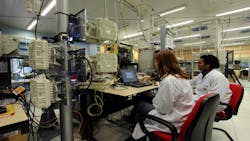
Legendary efforts and exploits have accounted for the rich history of this industry. Whether it was an engineer with a particular vision, or a facility that excelled in turning out innovations, the character of this industry has grown strong because of the integrity of many special individuals who have contributed to RF/microwave technology and its applications. Each year, to honor some of the noteworthy “chapters” in this history, another five persons, places, or things are added to our list of “Microwave Legends,” in the hopes that their stories will inspire the efforts of future generations.
ROGER POLLARD—Although born in London in 1946—and long associated with the University of Leeds, ever since earning a Bachelor of Science degree there in Electrical and Electronic Engineering—Pollard was probably more at home in the United States. He enjoyed a long association with what was then Hewlett-Packard Co. (now Agilent Technologies; www.agilent.com) starting in 1981. And he would make significant contributions to the development of that company’s landmark HP 8510A microwave vector network analyzer (VNA).
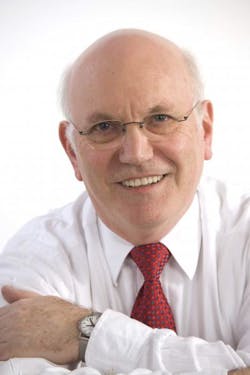
Roger Pollard was the first non-US-citizen President of the IEEE’s Microwave Theory & Techniques Society and a powerful guiding light for many in this industry involved in measurement technologies.
Pollard’s professional focus was on microwave solid-state devices and circuits. He was appointed Lecturer in the Department of Electrical and Electronic Engineering at Leeds in 1974 and awarded his Ph.D. in 1980, with a promotion to Senior Lecturer in 1985. At the same time, he served as a consultant to numerous RF/microwave companies, including HP/Agilent. He contributed to 10 books and about 150 articles, and lays claim to three patents. He also supervised over 50 Ph.D. candidates. He was elected a Fellow of the US Institute of Electrical and Electronic Engineers (IEEE) in 1997, and awarded the Measurement Prize by the UK Institution of Electrical Engineers (IEE) in 1999 and the IEEE Third Millennium Medal in 2000. In 2005, he was elected a Fellow of the Royal Academy of Engineering. He was also a Fellow of the Institution of Engineering and Technology.
Sadly, Pollard passed away early last December after a short illness. He was the first non-US citizen to hold the office of President of the IEEE Society Microwave Theory and Techniques Society. He contributed to the IEEE in a variety of capacities, including serving as Chair of the Technical Activities Board in 2010 and as leader in several key volunteer positions. In particular, he was a devoted volunteer to the IEEE’s Automatic RF Techniques Group (ARFTG), always in pursuit of the measurement truth (accuracy).
At the time of his death, Roger was the Secretary of the IEEE and a member of its Board of Directors.
JULIUS BOTKA—Although microwave circuits are electronic in nature, much of that high-frequency functionality would not be possible without extraordinary mechanical engineering, which yielded such components as coaxial connectors and adapters. And one of the industry’s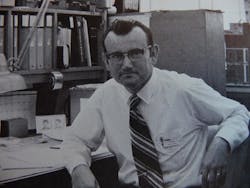
Botka has earned a total of 15 patents, including for a slotless microwave connector. He is also credited with extending the initial 1-GHz frequency limit of the Type N connector invented by Paul Neill at Bell Labs to its present-day limit of around 18 GHz. He joined HP/Agilent in 1966 and is currently Agilent R&D Project Manager for Microwave Components and Standards. In this role, he continues to contribute to precision components for the firm’s lines of test sets and microwave instruments.
CHARLES G. SMITH—Starting in 1922 with the design for a refrigerator, Charles G. Smith convinced his friend Laurence K. Marshall, Marshall’s friend Vannevar Bush, and various other investors to build a company around the refrigerator design. They collected enough money to start The American Appliance Company but, after three years, failed to produce a practical refrigerator. Hoping to salvage something from the venture, Marshall and Bush convinced Smith to convert the pump technology from the refrigerator into the design of vacuum tubes. In 1925, Smith had developed what he called a “gaseous rectifier”—a type of valve or vacuum tube for use in radios—allowing radios to work on AC power rather than on batteries. The tube was marketed as the Raytheon rectifier and, in 1927, the company was renamed Raytheon after its million-dollar product.
Microwave Legend Percy Spencer joined the company in 1925 and quickly contributed to the development of many different types of valves or microwave tubes, many of which would be used for the company’s growing radar systems business. The concept of radar (radio detection and ranging) began in the early 1900s, but the availability of the high-power electron devices—such as Raytheon’s magnetrons—made the realization of working radar systems possible, and a key ingredient in the coming World War II.
BELL LABS—at one time known as AT&T Bell Laboratories, and now the research & development (R&D) arm of the French-owned Alcatel-Lucent (www.alcatel-lucent.com), this has been one of the world’s top research facilities for microwave, optical, and other electronic technologies. As the Alexander Graham Bell Laboratory, it opened in Washington, DC in 1880 supported largely by grant money from the French government. The telephone’s inventor focused early efforts on recording and processing telephone signals, although he also hoped to increase public knowledge about the deaf and hearing defects.
In 1925, with the consolidation of Western Electric’s research laboratories and part of the engineering department of the American Telephone & Telegraph (AT&T) company, the facility became Bell Telephone Laboratories; ownership of the laboratory was split between Western Electric and AT&T. The laboratory became home for many of the technically famous, including Richard Hamming (Hamming codes for error detection and correction), Harry Nyquist, and William Shockley (the inventor of the transistor). Bell Labs was also a starting point for many key technologies, including charge-coupled devices (CCDs), light-wave communications, and radio astronomy. In 1962, the laboratory launched the first communications satellite, Telstar I, with a 2-W, 4-GHz RCA traveling-wave-tube (TWT) amplifier.
MIT LINCOLN LAB—With roots in the Massachusetts Institute of Technology (MIT) Radiation Laboratory—which was in turn formed out of the university’s Physics Department, for the purpose of developing radar technology in support of the Allied Forces during World War II—MIT’s Lincoln Laboratory has a rich history in support of the use of technology in defense of the US. The laboratory was commissioned by the US Department of Defense to design and develop the first air defense system for the US, largely in response to the detonation of the first Soviet atomic bomb in 1949.
About the Author
Jack Browne
Technical Contributor
Jack Browne, Technical Contributor, has worked in technical publishing for over 30 years. He managed the content and production of three technical journals while at the American Institute of Physics, including Medical Physics and the Journal of Vacuum Science & Technology. He has been a Publisher and Editor for Penton Media, started the firm’s Wireless Symposium & Exhibition trade show in 1993, and currently serves as Technical Contributor for that company's Microwaves & RF magazine. Browne, who holds a BS in Mathematics from City College of New York and BA degrees in English and Philosophy from Fordham University, is a member of the IEEE.