The State of Wi-Fi in 2026
What you'll learn:
- The growth of Wi-Fi with continued development of Wi-Fi 6, 6E, and 7.
- A look at the enhancements coming with Wi-Fi 8.

If it wasn't already clear to everyone, it is now: The world runs on Wi-Fi. It's relied on by virtually every business on the planet to collect and redistribute data, whether it's within an office, a campus, or industrial facilities.
On the home front, it keeps us connected to our servers and smart-home gear. Without it, I'd burn through my whole family's allotment of cellular data within the first week of the billing cycle.
A new whitepaper from ABI Research shines a spotlight on the current state of Wi-Fi and the outlook for its future in the enterprise and, well, everywhere. Let's take a quick look at some of it.
A key finding of the report is how heavily enterprise Wi-Fi relies on unlicensed spectrum. Back in the day, there was more than enough spectrum to go around in the 2.4- and 5-GHz bands, but that's no longer true and hasn't been for some time.
In April of 2020, the Federal Communications Commission (FCC) opened up 1,200 MHz in the 6-GHz band for unlicensed use and that, coupled with the development of Wi-Fi 6E and Wi-Fi 7, fueled a rise of innovation in the Wi-Fi universe.
Enterprises jumped onboard with that gift of unlicensed spectrum. Other countries took their cues from the U.S., making similar changes in their own spectrum allocations to free up local businesses in the 6-GHz band (although Europe and China have lagged behind).
Meanwhile, channel bandwidths have proliferated from 20 to 320 MHz. Absent that development, there's no way enterprises would be able to deal with the many thousands of network users of high-bandwidth, low-latency applications in use cases like research labs or medical scenarios.
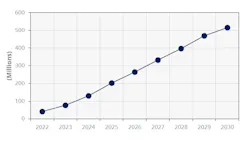
ABI Research's forecast for shipments of 6-GHz chipsets (see figure) shows growth commensurate with the rapid rise in spectrum usage. In fact, the current forecast projects shipment levels that are about 25% greater than those of ABI's 2024 outlook. In 2025, shipments were in the 203M ballpark. By 2030, we're talking 515M chipsets going out of vendors' doors.
The result has been an explosion in Wi-Fi usage, which will in turn create pressure on regulators to not only continue their support for unlicensed usage of the full 6-GHz band, but also extend that freedom into the 7-GHz slice from 7,125 to 7,250 MHz.
Coming Soon to Routers Near You: Wi-Fi 8
With all of the foregoing said, Wi-Fi must raise its own game to stay ahead of users' insatiable demand for bandwidth, low latency, and ubiquitous access. Enter the advent of Wi-Fi's 8th generation, which will emphasize ultra-high reliability through the addition of numerous features enhancing connectivity and efficiency in data transfers.
Like Wi-Fi 7, Wi-Fi 8 will range up to 7,250 MHz to enable it to provide a fourth 320-MHz-wide network channel. This is a boon for data-intensive applications like factory automation, artificial intelligence, and augmented/virtual reality (AR/VR). But Wi-Fi 8's feature set assumes availability of the entire 6-GHz band and anticipates the addition of 7-GHz spectrum.
Overall, ABI's outlook for Wi-Fi in 2026 and beyond envisions a very bright future. The availability of reliable and capable Wi-Fi networks is critical to the needs of university campuses, stadiums and arenas, healthcare, and industry. I'm looking forward to keeping track of how the situation unfolds.
About the Author
 David Maliniak
David Maliniak
Executive Editor, Microwaves & RF
I am Executive Editor of Microwaves & RF, an all-digital publication that broadly covers all aspects of wireless communications. More particularly, we're keeping a close eye on technologies in the consumer-oriented 5G, 6G, IoT, M2M, and V2X markets, in which much of the wireless market's growth will occur in this decade and beyond. I work with a great team of editors to provide engineers, developers, and technical managers with interesting and useful articles and videos on a regular basis. Check out our free newsletters to see the latest content.
You can send press releases for new products for possible coverage on the website. I am also interested in receiving contributed articles for publishing on our website. Use our contributor's packet, in which you'll find an article template and lots more useful information on how to properly prepare content for us, and send to me along with a signed release form.
About me:
In his long career in the B2B electronics-industry media, David Maliniak has held editorial roles as both generalist and specialist. As Components Editor and, later, as Editor in Chief of EE Product News, David gained breadth of experience in covering the industry at large. In serving as EDA/Test and Measurement Technology Editor at Electronic Design, he developed deep insight into those complex areas of technology. Most recently, David worked in technical marketing communications at Teledyne LeCroy, leaving to rejoin the EOEM B2B publishing world in January 2020. David earned a B.A. in journalism at New York University.
Related
 Leaders Logo
Leaders relevant to this article: