SBC Facilitates AI-Powered Machine Vision and Sound
What you'll learn:
- Main features of the Arduino UNO Q SBC.
- AI acceleration via the integration of App Lab with the Edge Impulse platform.
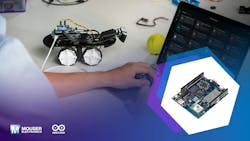
The recently released UNO Q single-board computer from Arduino, which helps foster AI-driven machine-vision and -sound solutions in IoT and other devices, bridges high-performance computing with real-time control. Features include a “dual brain” architecture with a Linux Debian-capable Qualcomm Dragonwing QRB2210 microprocessor , plus a real-time STM32U585 microcontroller from STMicroelectronics.
Offering integrated AI acceleration with camera, display, and audio support, the QRB2210 microprocessor serves next-gen robotics and IoT products. The compact, cost-effective UNO Q leverages a quad-core 2.0-GHz CPU, Adreno GPU, and 2x ISP.
The ABX00162 UNO Q features 2 GB of RAM and 16 GB of onboard eMMC storage, and the pre-loaded Arduino App Lab offers developers an open-source platform to rapidly develop AI-powered solutions.
Integration of App Lab with the Edge Impulse platform also helps streamline and accelerate the process of building, fine-tuning, and optimizing AI models. Real-world data is used for a wide range of applications, such as object/human detection, anomaly detection, image classification, ambient sound recognition, and keyword spotting.
The UNO Q comes with a pre-installed wireless module for dual-band Wi-Fi 5 (2.4/5 GHz) and Bluetooth 5.1 for wireless connectivity, with classic UNO headers, high-speed bottom headers, and a Qwiic I2C connector for easy expansion. Furthermore, the SBC includes an onboard USB-Type C connector with power-delivery input and video output, and an 8×13 LED matrix for visual creation and feedback.
Related links:
More New Products
About the Author

Alix Paultre
Editor-at-Large, Microwaves & RF
Alix is Editor-at-Large for Microwaves & RF.
An Army veteran, Alix Paultre was a signals intelligence soldier on the East/West German border in the early ‘80s, and eventually wound up helping launch and run a publication on consumer electronics for the U.S. military stationed in Europe. Alix first began in this industry in 1998 at Electronic Products magazine, and since then has worked for a variety of publications, most recently as Editor-in-Chief of Power Systems Design.
Alix currently lives in Wiesbaden, Germany.